What Origin Is Corned Beef Hhash
/https://tf-cmsv2-smithsonianmag-media.s3.amazonaws.com/filer/20130315084056corned-beef-cabbage-st-patricks-day-web.jpg)
It'due south hard to remember of St. Patrick'southward 24-hour interval without glittered shamrocks, green beer, leprechauns, and of course, corned beefiness and cabbage. Yet, if y'all went to Ireland on St. Paddy'southward Day, you would not notice whatsoever of these things except maybe the glittered shamrocks. To begin with, leprechauns are non jolly, friendly cereal box characters, but mischievous nasty little fellows. And, just equally much as the Irish would non pollute their beer with greenish dye, they would non eat corned beef, especially on St. Patrick's Day. So why around the earth, specially in the United states, is corned beef and cabbage synonymous with St. Paddy's Twenty-four hours?
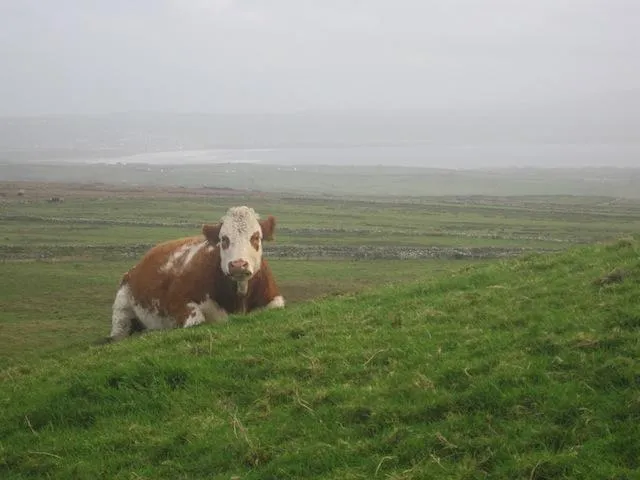
The unpopularity of corned beef in Ireland comes from its relationship with beef in general. From early on, cattle in Ireland were non used for their meat only for their strength in the fields, for their milk and for the dairy products produced. In Gaelic Ireland, cows were a symbol of wealth and a sacred animal. Because of their sacred clan, they were only killed for their meat if the cows were too quondam to work or produce milk. So, beef was not even a part of the diet for the majority of the population. Only the wealthy few were able to eat the meat on a celebration or festival. During these early times, the beef was "salted" to be preserved. The first salted beefiness in Ireland was actually not made with salt merely with sea ash, the production of called-for seaweed. The 12th century verse form Aislinge Meic Con Glinne shows that salted beef was eaten by the kings. This poem is one of the greatest parodies in the Irish language and pokes fun at the nutrition of King Cathal mac Finguine, an early Irish King who has a demon of gluttony stuck in his throat.
Wheatlet, son of Milklet,
Son of juicy Salary,
Is mine own name.
Honeyed Butter-whorl
Is the man's
That bears my bag.
Haunch of Mutton
Is my dog'south name,
Of lovely leaps.
Lard my wife,
Sweetly smiles
Across the kale-top
Cheese-curds, my daughter,
Goes effectually the spit,
Off-white is her fame.
Corned Beef, my son,
Whose mantle shines
Over a large tail.
As the poem mentions, juicy bacon or pork was as well eaten. Pigs were the nigh prevalent animal bred but to be eaten; fom ancient times to today, it earned the reputation as the most eaten meat in Ireland.
The Irish gaelic diet and fashion of life stayed pretty much the same for centuries until England conquered most of the land. The British were the ones who changed the sacred moo-cow into a commodity, fueled beef product, and introduced the potato. The British had been a beef eating civilization since the invasion of the Roman armies. England had to outsource to Ireland, Scotland and somewhen North America to satisfy the growing palate of their people. As Jeremy Rifkin writes in his book, Beyond Beef: The Rise and Fall of the Cattle Culture, "so beef-driven was England that it became the first nation in the world to identify with a beef symbol. From the commencement of the colonial era, the "roast beef" became synonymous with the well-fed British aristocracy and eye form."
Herds of cattle were exported by the tens of thousands each year from Ireland to England. Merely, the Cattle Acts of 1663 and 1667 were what fueled the Irish corned beef industry. These acts prohibited the consign of live cattle to England, which drastically flooded the Irish market place and lowered the cost of meat available for salted beefiness production. The British invented the term "corned beef" in the 17th century to describe the size of the common salt crystals used to cure the meat, the size of corn kernels. After the Cattle Acts, salt was the main reason Ireland became the hub for corned beef. Ireland's salt taxation was almost ane/ten that of England'south and could import the highest quality at an inexpensive price. With the large quantities of cattle and high quality of salt, Irish corned beefiness was the best on the marketplace. It didn't accept long for Ireland to exist supplying Europe and the Americas with its wares. But, this corned beef was much different than what we call corned beef today. With the meat being cured with common salt the size of corn kernels, the gustation was much more than salt than beefiness.
Irish corned beef had a stranglehold on the transtlantic trade routes, supplying the French and British navies and the American and French colonies. It was at such a need that even at state of war with France, England immune French ships to end in Republic of ireland to purchase the corned beef. From a report published by the Dublin Found of Engineering's School of Culinary Arts and Food Technology:
Anglo-Irish landlords saw exports to French republic, despite the fact that England and French republic were at state of war, as a ways of profiting from the Cattle Acts…During the 18th century, wars played a meaning part in the growth of exports of Irish beefiness. These wars were mainly fought at sea and navies had a high demand for Irish salted beef for 2 reasons, firstly its longevity at body of water and secondly its competitive price.
Ironically, the ones producing the corned beefiness, the Irish people, could not afford beef or corned beefiness for themselves. When England conquered Republic of ireland, oppressive laws against the native Irish Catholic population began. Their land was confiscated and feudal like plantations were set upward. If the Irish could afford any meat at all, salted pork or bacon was consumed. But, what the Irish gaelic actually relied on was the spud.
Past the stop of the 18th century, the need for Irish corned beefiness began to decline as the North American colonies began producing their own. Over the next 5o years, the glory days of Irish corned beefiness were over. By 1845, a potato bane bankrupt out in Ireland completely destroying the food source for nigh of the Irish population, and The Neat Famine began. Without help from the British authorities, the Irish people were forced to work to death, starve or emigrate. About a million people died and another million immigrated on "coffin ships" to the US. To this twenty-four hours, the Irish gaelic population is still less than it was before The Swell Dearth.

In America, the Irish gaelic were one time again faced with the challenges of prejudice. To make it easier, they settled together in mainly urban areas with the largest numbers in New York City. However, they were making more money and so they had in Ireland under British rule. Which brings us back to corned beef. With more money for food, the Irish gaelic could beget meat for the first time. But instead of their beloved bacon, the Irish gaelic began eating beef. And, the beef they could afford just happened to be corned beefiness, the thing their slap-up grandparents were famous for.
Yet, the corned beef the Irish immigrants ate was much dissimilar than that produced in Ireland 200 years prior. The Irish immigrants nearly solely bought their meat from kosher butchers. And what we call up of today equally Irish gaelic corned beef is actually Jewish corned beef thrown into a pot with cabbage and potatoes. The Jewish population in New York Urban center at the time were relatively new immigrants from Eastern and Central Europe. The corned beef they fabricated was from brisket, a kosher cut of meat from the forepart of the moo-cow. Since brisket is a tougher cut, the salting and cooking processes transformed the meat into the extremely tender, flavorful corned beefiness nosotros know of today.
The Irish may have been drawn to settling near Jewish neighborhoods and shopping at Jewish butchers considering their cultures had many parallels. Both groups were scattered across the earth to escape oppression, had a sacred lost homeland, discriminated against in the U.s.a., and had a beloved for the arts. There was an understanding between the ii groups, which was a comfort to the newly arriving immigrants. This relationship tin can be seen in Irish, Irish-American and Jewish-American folklore. Information technology is not a coincidence that James Joyce made the main character of his masterpiece Ulysses, Leopold Blossom, a human born to Jewish and Irish parents. And, as the 2 Tin Pan Alley songwriters, William Jerome and Jean Schwartz write in their 1912 song, If Information technology Wasn't for the Irish and the Jews,
On St. Patrick'south Mean solar day, Rosinsky pins a shamrock on his coat
At that place's a sympathetic feeling betwixt the Blooms and MacAdoos.
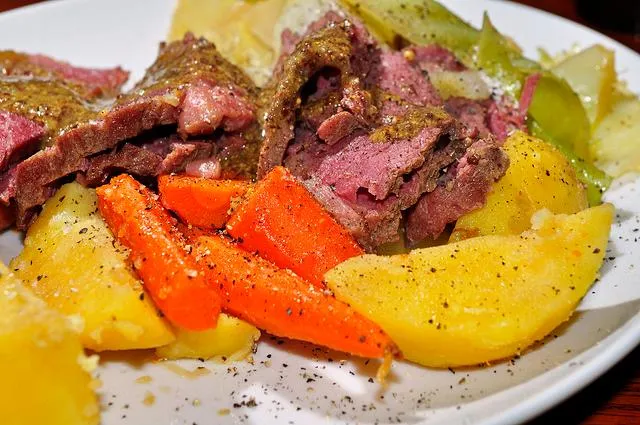
The Irish Americans transformed St.Patrick's Day from a religious feast day to a commemoration of their heritage and homeland. With the commemoration, came a celebratory repast. In honor of their culture, the immigrants splurged on their neighbor's flavorful corned beef, which was accompanied past their beloved spud and the well-nigh affordable vegetable, cabbage. It didn't take long for corned beef and cabbage to become associated with St. Patrick'due south Day. Maybe it was on Lincoln'south heed when he chose the card for his get-go Inaugural Tiffin March 4, 1861, which was corned beef, cabbage and potatoes.
The popularity of corned beef and cabbage never crossed the Atlantic to the homeland. Instead of corned beef and cabbage, the traditional St. Patrick'south Day meal eaten in Ireland is lamb or bacon. In fact, many of what we consider St. Patrick's Day celebrations didn't make information technology there until recently. St. Patrick'south Day parades and festivals began in the US. And, until 1970, pubs were closed by police in Ireland on St. Patrick's Solar day. Information technology was originally a day about religion and family. Today in Ireland, thanks to Irish tourism and Guinness, you will find many of the Irish American traditions.
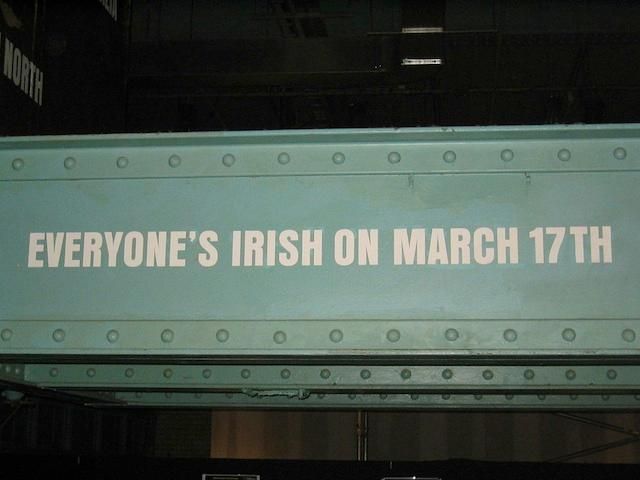
Lastly, if y'all are looking for a connection to the home country this vacation, there are many other means to be authentic. For starters, know that the vacation is either St. Patrick'southward Twenty-four hour period or St. Paddy'due south Day and not "St. Patty's Solar day". (Paddy is the proper nickname for Patrick, while Patty is a daughter's proper name in Ireland.)
Editor'south note, March 17, 2021: The final paragraph of this story has been edited to improve reflect the proper nomenclature for celebrating St. Paddy's Day.
Source: https://www.smithsonianmag.com/arts-culture/is-corned-beef-really-irish-2839144/
0 Response to "What Origin Is Corned Beef Hhash"
Enregistrer un commentaire